
Cutting downtime at an Underground Gold Mine
How TMS® improved safety, reduced tire damage and allowed for faster tire exchange to reduce downtime
Overview
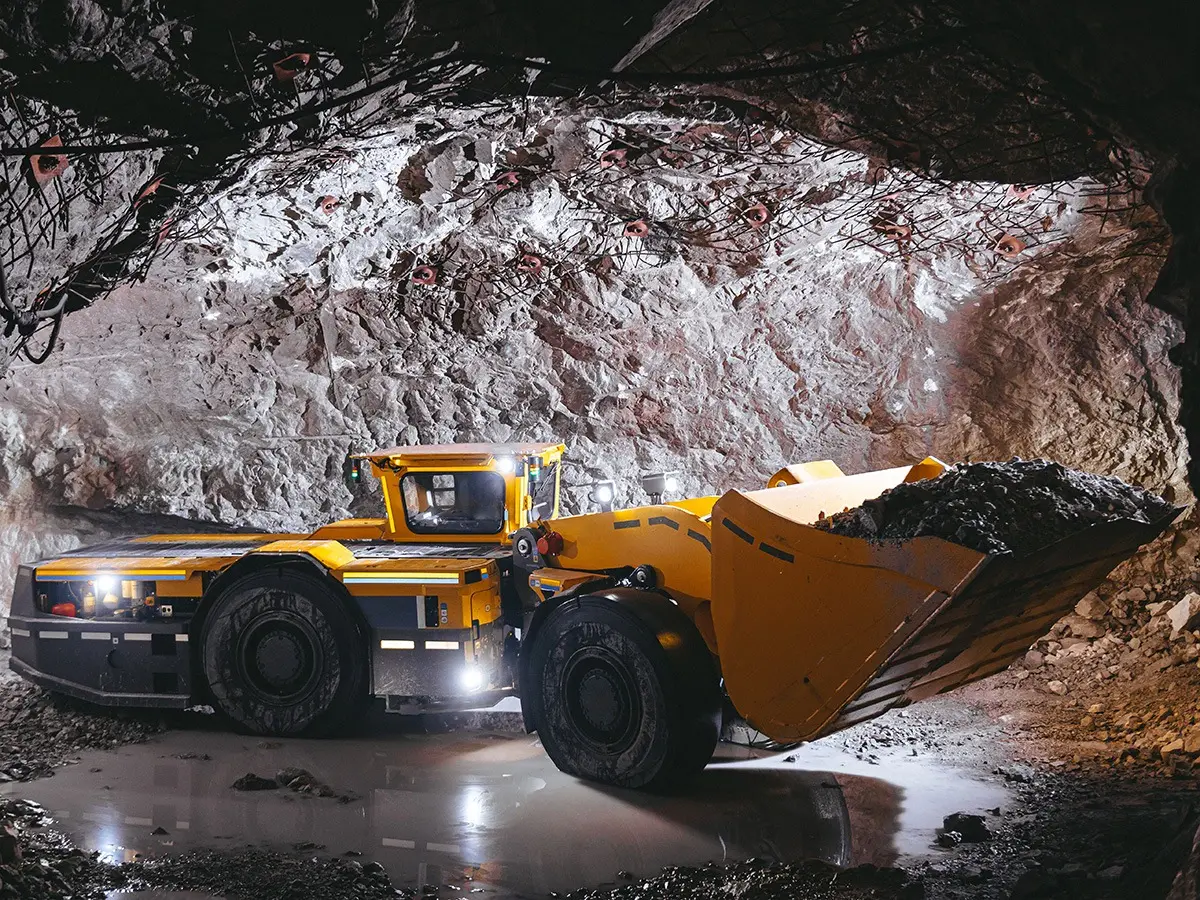
The underground mine customer operates a large number of Load Haul Dump (LHD) Trucks from major vehicle manufacturer Epiroc. They were experiencing excessive tire damage and high and increasing vehicle downtime related to tire issues.
Underground mining represents one of the toughest operating environments for Off-the-Road (OTR) tires. Often the best quality tire manufacturers can only achieve running hours of 1000-2000 hours. In some situations, this is barely making 1000 hours.
The client asked TMS® to provide TPMS systems to help understand the reasons behind this ongoing tire problems.
The challenge
- Tire operating hours falling short of company targets
- Time-consuming, high-risk manual pressure checks
- Risk of TPMS damage from loose rocks in confined tunnels
Underground communications
Despite there being no mobile signal and no GPS signal underground, the customer wanted to monitor the system remotely and store all the tire data in the Cloud. The mine had a number of locations with WiFi coverage where the LHD vehicle passed. Using the Airlink option with the TPMS, the system is able to update the tire data to the Cloud every time the vehicles passed the WiFi zone. The TMS-Cloud application displays this data, allowing teams to analyse tire pressures and temperatures in detail over any selected time period..
Combined with an Operator Interface in the cab, the mine can make immediate decisions when a tire alarm or warning occurs and still have a comprehensive log of all the tire data for later review and analysis.
Even when the vehicle travels out of Wi-Fi range, the Hub constantly time-stamps and stores all tire data. The LHD then transmits this data to the Cloud as soon as it passes through a Wi-Fi zone. This process only takes a few seconds so happens automatically without the operators even being aware. This process completely eliminates the risk of lost data.
Sensor and antenna placement
The vehicle has to move in extremely confined spaces underground so this means it?s necessary for a TPMS system to be specified for this situation. External sensors often mount on the valve stem, but flying rocks and tunnel walls would quickly damage them in underground mines. Therefore, the team selected internal sensors, which mount magnetically directly onto the wheel rim. This gives the added benefit of accurate monitoring of the tire temperature.
The same principle applied to the aerials. Mounting them on the exterior left them vulnerable to damage, so the team moved the RF aerials inside the vehicle. Thanks to multiple aerial inputs and an extremely sensitive receiver, this setup worked perfectly without missing a single signal from any wheel.
Tire pressure manual checks
Another consequence of working underground is the confined space to undertake manual pressure checks. This activity is time consuming and potentially high risk because of the poor visibility and small amount of space available around the vehicle. Using the TPMS, the company has mostly removed the need for manual tire pressure checks. As a final safety measure, technicians still perform manual checks, but they now carry them out after moving the vehicle to the maintenance area. Management has significantly reduced the frequency of these checks and plans to reduce it further over time.
Mine operators seize every opportunity to eliminate manual checks outside the vehicle, keeping personnel out of harm’s way.
Avoiding scrap tires
Shortly after installing the TPMS, the system alerted an operator to low pressure on specific tires on two separate occasions. This allowed the fleet manager to stop the vehicle immediately, replace the tire, and prevent further damage. Prior to the use of the TPMS systems there would be no way for the operators to know there was an issue until it was too late and the tires would end up with further damage that would prevent any possible repair, forcing the company to scrap the tires.
Each one of the tires saved would have paid for the TPMS system many times over.
Because of the nature of the environment, this situation will recur multiple times over the life of the TPMS system, making the financial argument for investing in TPMS a very simple one. The simple process of reviewing the investment shows a payback in just a few months.
Additional notification
Underground mines create notoriously noisy working environments, and vehicle cabs offer extremely limited space. Because drivers often miss standard alarms in these conditions, the TMS® system can include an additional siren and beacon. This instantly alerts the driver to a tire alarm, ensuring they never overlook a critical issue.
Avoiding production downtime
Performing maintenance in-situ is virtually impossible, so technicians must move the vehicle to a maintenance area or bring it above ground to work on the wheels and tyres. To minimise downtime, the customer keeps a spare wheel pre-fitted with a TPMS sensor, allowing staff to swap out the damaged wheel quickly.
The team then transports the damaged wheel to a remote maintenance area for repair or retreading. Using the in-cab display, the technician pairs the new sensor (pre-fitted in the new wheel) to the Hub in just a few seconds.
Data security
All customers are sensitive about their operational data and gold mines are even more so. With TMS® the data is always owned and controlled by the user. TMS® may use the data to assist users with the management of their vehicles but the ownership remains with the customer, and no third party is ever given access to this sensitive data.
We have found that some mines have internal IT policies that don?t allow any third-party devices to connect to the WiFi. In these situations, the data can be extracted from the Hub and automatically emailed to the fleet manager. When this is opened up in the App, the data can be viewed in exactly the same way but without any connection between the TMS® hardware and the customer?s IT system.
The Outcome
The environment is extremely demanding, but the TPMS systems continue to operate reliably. The mine operators and manager now have full visibility and the following advantages: –
- Receive immediate notification of tires running outside agreed parameters
- Minimise downtime by pre-fitting sensors to spare wheels
- Improve operator safety by reducing time spent on manual pressures checks
- Stay fully informed on tire performance, even with no mobile or GPS signal underground.
- Even after a short period, the system identified tire events which would never have been spotted previously. These events have already saved many times the value of the TPMS system
ROI and future planning
TMS® provides a comprehensive Return on Investment Calculator capable of modelling complete mining fleets to estimate potential savings from implementing a high-quality TPMS solution. To see the ROI figures for your site, please contact us today.